I sometimes hear photographers say they don’t use filters because filters change reality. I always wonder how those same photographers feel about their choice of lens, because a lens changes the look of reality far more dramatically than any filter ever will. Understanding how is one of the most useful things you can learn about landscape photography.
What Lens Compression Actually Is
Every lens renders distance differently. A telephoto lens compresses the scene. It makes things that are far apart look closer together and larger relative to each other. A wide angle lens does the opposite. It stretches the scene out, making things look further apart and smaller than they appear to the eye.
This a tool that you can use in your photos. Once you start thinking about it deliberately, it changes how you approach every scene you photograph.

The Same Scene, Two Different Lenses
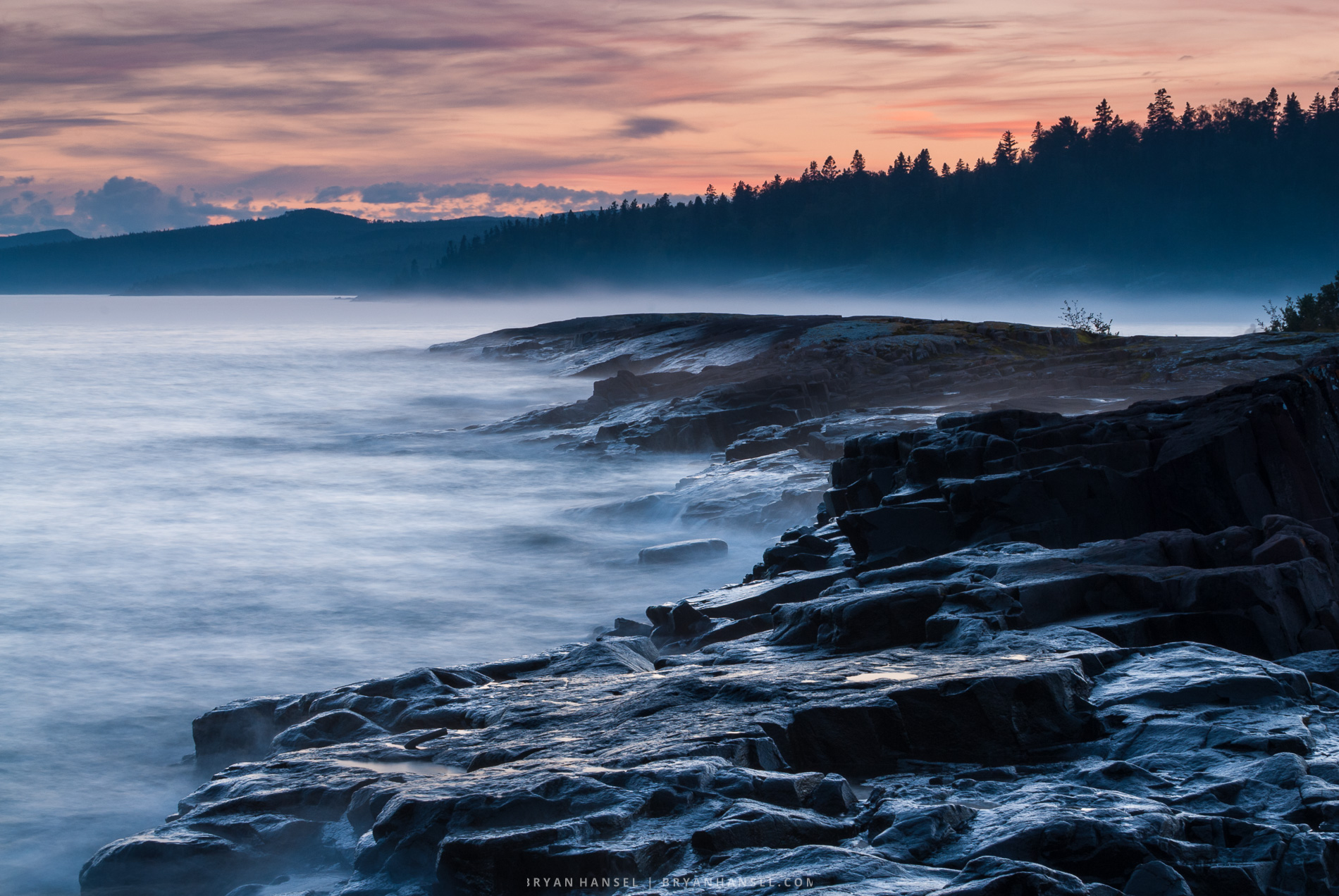
There’s a point on Lake Superior near Grand Marais where you can see the Sawtooth Mountains in the distance. I’ve photographed that scene many times, and I want to walk through two versions of it to show what I mean.
In the first version, shot at 200mm, the mountains look close and almost like they’re right behind the point. In reality the mountains are miles away and the point itself is about a quarter mile from where I was standing. The telephoto compressed all of that distance into a single frame and made everything feel stacked together.
In the second version, shot at 16mm from roughly the same position, you can see the same point, but now it’s small, pushed into the distance by the wide angle. The mountains are even further back, barely registering on the horizon. The same scene, the same two landmarks, but they look like they’re in completely different relationships to each other.
Neither version is more accurate than the other. They’re just different interpretations of the same place.

How to Think About It Before You Shoot
When I arrive at a scene, one of the first questions I ask is whether the scene will look better spread out or compressed. It sounds simple, but it’s a question most photographers never consciously ask. They just put on whatever lens they grabbed from the bag.
If the interesting thing about the scene is the scale and space — a wide open valley, a long stretch of shoreline, a sky that goes forever — a wide angle will serve that. Get close to something in the foreground and let the lens do what it does naturally.
If the interesting thing is the relationship between elements that are far apart — a distant mountain behind a nearby lighthouse, a setting sun behind a ridge, a bird on a rock with cliffs behind it — a telephoto will compress those elements together and make that relationship visible in a way your eye can actually see it.
The Telephoto Trap
Most landscape photographers default to wide angle because wide angle feels like landscape photography. There’s nothing wrong with that — wide angle lenses are incredibly powerful for landscapes when used correctly. But a lot of photographers almost never pick up a telephoto for landscape work, and they’re leaving a huge range of possibilities on the table.
If you’ve never deliberately used a telephoto for landscapes, the first thing you’ll notice is that you have to move back — sometimes a lot further back than feels natural — to get the elements you want into the frame. That’s the lens working. You’re trading field of view for compression, and the further you step back, the more pronounced the compression effect becomes.
The Exercise
Find a scene with some depth to it — a foreground element with something interesting in the middle distance or background. Photograph it at your widest focal length. Then step back, switch to a telephoto, and photograph the same basic composition. Don’t just compare the images on the back of the camera — look at them side by side on a screen.
The difference will change how you see every scene you photograph after that.
If you want to dig into the wide angle side of this, read my post on how to use a wide angle lens for landscape photography.
Leave a Reply