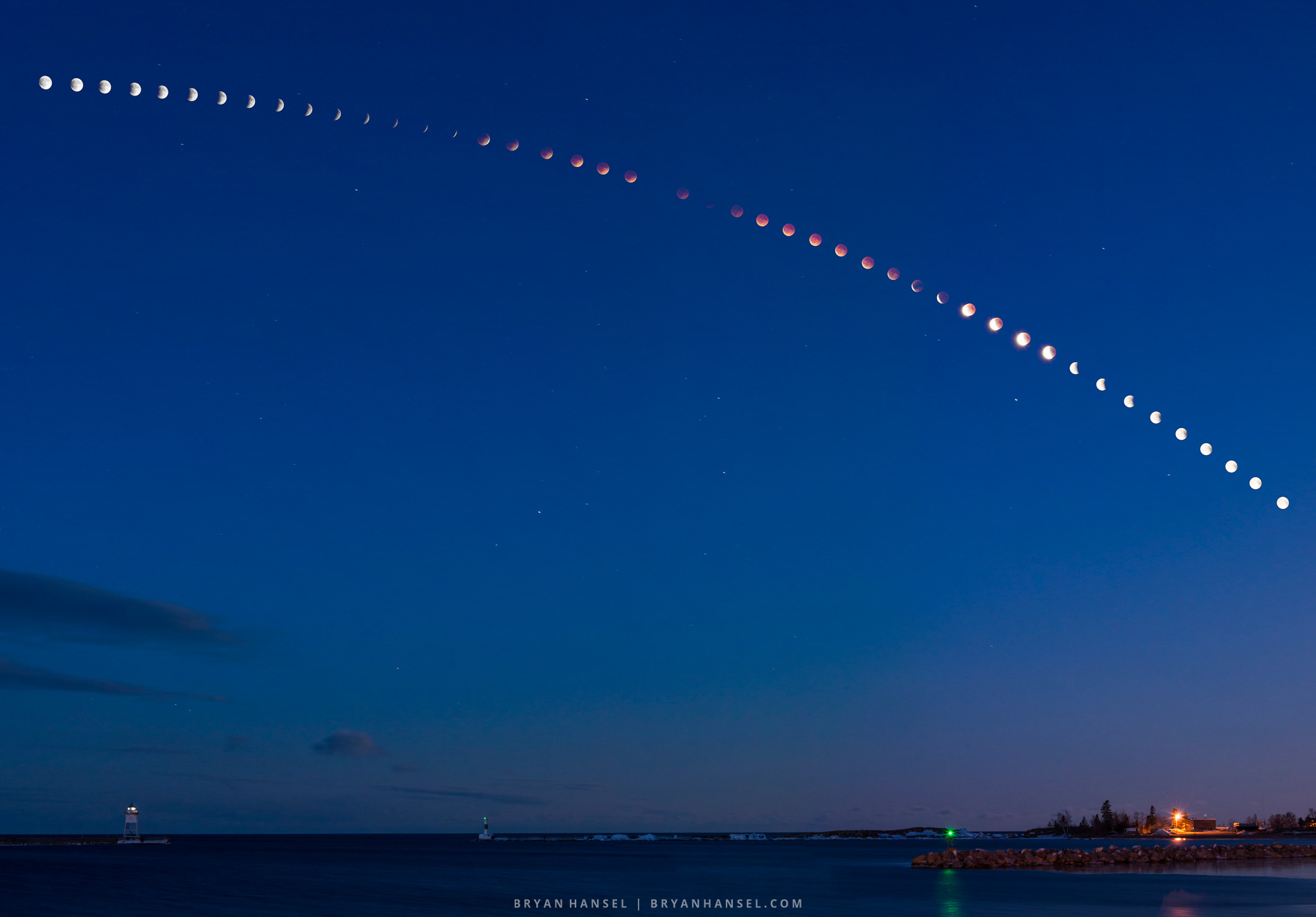
A lunar eclipse is one of those events that gets overhyped by the media and underestimated by photographers. Everyone wants a shot of the blood moon, but most people just point a telephoto at it and call it done. I wanted something more — not just the eclipse itself, but the full arc of the moon’s journey through the night, set against a recognizable foreground. Here’s how I planned and built that image.
The Planning
The image I had in mind required knowing exactly where the moon was going to be at every stage of the eclipse: before, during, and after totality. I used The PhotoPills to calculate the moon’s position and track its path through the sky over Grand Marais. Once I knew the arc, I could find a spot in town where that path would line up with something interesting in the foreground. I settled on a position that put the lighthouse in the frame.
Focal length matters more than people think for this kind of shot. I knew I wanted to use 50mm, which is wide enough to show the full arc of the moon across the sky, but long enough that if I printed it large the moon would have real detail in it rather than just being a bright dot. Getting the focal length right before you go out saves a lot of frustration on location.
The Shooting
I ran two cameras that night. The first was set up for the wide panoramic shot with the lighthouse and harbor. The second was zoomed in tight on the moon to capture detail during the eclipse itself.
The wide shot is a panoramic composite made from three separate frames shot at different points along a camera pan: left side with the lighthouse, middle with the western marker, and right side covering the marina. Each frame overlapped the next by about 20 to 25%, which gave me enough shared detail to stitch them together in Photoshop.
Here’s the part that took the most coordination: each individual moon in the final image comes from a separate shot taken during the corresponding panoramic position. So while I was shooting the left third of the panorama, I also captured the moons that belonged in that section of the sky. Then I rotated to the middle position and captured the next group of moons. Then the right position for the last group. You have to think through the timing carefully before you start. Once the eclipse is moving, you don’t get a second chance.
At dawn, after the eclipse was over, I reshot all three panoramic positions with the brighter morning light to get cleaner base images for the background.

The Compositing
Back at the computer, I stitched the dawn panoramic frames into one large base image. Then I went through each individual moon shot and placed it where it belonged in the arc — lining each one up with its correct position in the sky relative to the foreground.
I got lucky in one respect: the lighthouse was visible in some of the moon shots, which gave me reference points to work from. Without that, the alignment would have been mostly guesswork.
The main problem I ran into was parallax. When you pan a camera for a panoramic shot without a specialized nodal point tripod head, the perspective shifts slightly between frames — objects at different distances don’t line up perfectly when you stitch. Because of that, the moons didn’t fall into a clean, mathematically precise arc the way I’d hoped. In the end I drew a curve through the moons and nudged a few of them onto it. Whether it’s a accurate arc or not, I can’t say, but it looks right, and the final image captures the feeling of the night better than a technically perfect version probably would have.
What I’d Do Differently
A nodal point panoramic head would have solved the parallax problem and made the compositing much cleaner. If you’re planning a shot like this, it’s worth the investment.
I’d also plan the moon timing even more carefully. Knowing exactly which moon phases I needed to capture during each panoramic position, and having that written down before I started shooting would have made the night go more smoothly.
One Last Thing
Lunar eclipses are predictable years in advance. NASA publishes eclipse schedules far into the future, so there’s no excuse not to plan. Find the next one, spend an hour in PhotoPills figuring out where the moon will track over a foreground you care about, and go make something more interesting than a telephoto closeup of a red moon.

Leave a Reply