A year on the road — about 100 days, 20 workshops, and locations spanning Death Valley to Glacier National Park. Here are my favorite shots from 2018, with the story and technique behind each one.
January

Artist’s Point is one of my most-photographed locations on Lake Superior, and I’d shot this specific corner of it dozens of times. But on the first sunrise of 2018, I found a composition I’d never seen before. The sea smoke, soft colors, and long-exposure blur of the water came together into what felt like the right way to start a new year.
February

I was teaching a night photography workshop when the moon rose over the Tombolo. The added moonlight changed my approach entirely — instead of shooting wide open at f/2.8 as I normally would for night work, I stopped down to f/11 and focused the way I would for a landscape shot rather than locking focus at infinity. The result was sharp depth of field through the entire frame, something you rarely get in night photography.
March

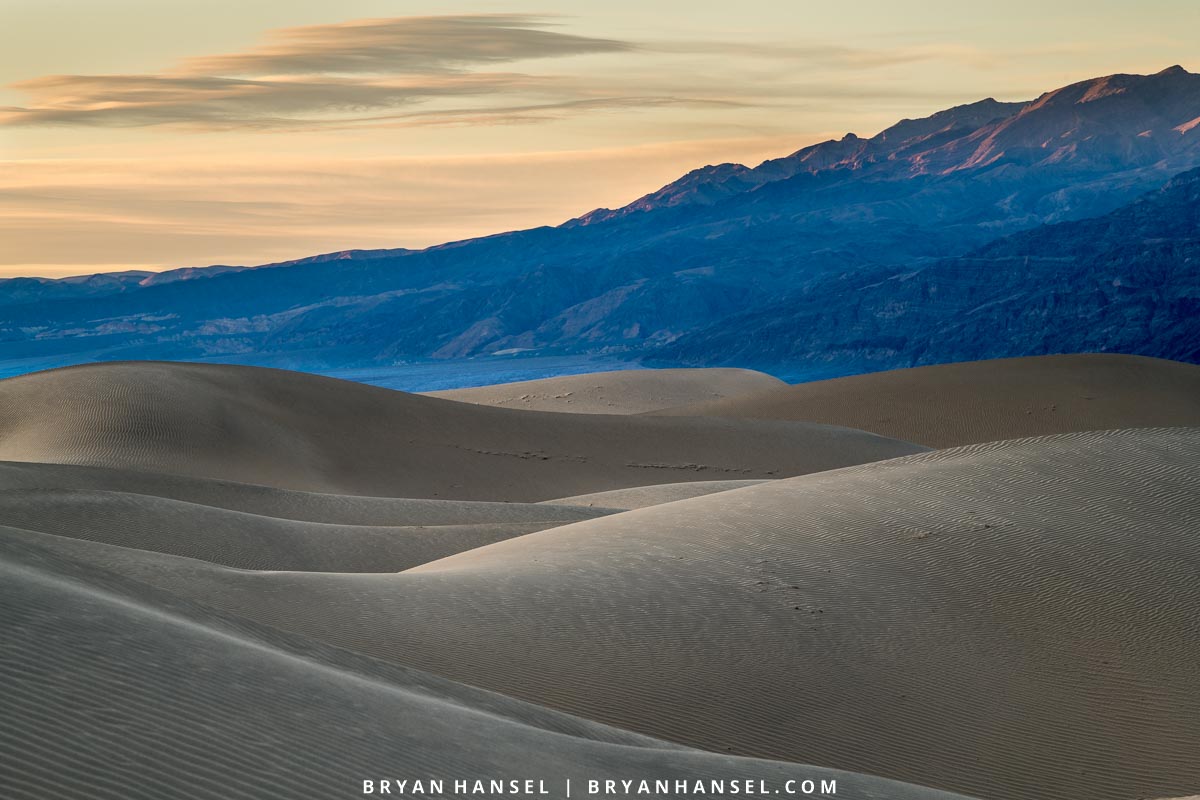
My first trip to Death Valley and my first time photographing sand dunes. A sandstorm the day before had scoured most of the footprints off the dunes, which was a lucky break — clean dune lines make a huge difference compositionally. The last light of the day was catching the mountain peaks in the background while the dune shapes caught the subtle colors of sunset. I’ve wanted to go back ever since.
April

I’ve shot this scene several times, but the alpenglow on this particular morning was unlike anything I’d seen there before. Just before sunrise, pink and orange light scattered across the horizon and over the Sawtooth Mountains, the lighthouse, and the breakwater all at once. Some mornings just align perfectly.
May

Buck Hill is my favorite sunrise location in Theodore Roosevelt National Park. On this morning I was teaching a workshop, so I got to share one of the best sunrises I’ve witnessed in the park with ten other photographers. Those are the mornings that make teaching worth it.
June

On the last evening of a workshop, the group was tired and reluctant to drive far. I gave them a choice: an okay spot nearby, or a 45-minute drive to a location I knew would deliver. They went for it. This image is what happened.
July

A summer sunrise back at Artist’s Point, shooting from my usual July position. The mood of the image reads more like fall than summer — dark, still, and a little brooding. The puddle in the foreground was something I’d walked past countless times without noticing. It was almost a throwaway frame on location, but once I saw it on screen it became one of my favorites of the year.
August

To capture the Perseid meteor shower, I set my camera to shoot continuous 30-second exposures for several hours — 208 frames in total. Back in Lightroom and Photoshop, I sorted through every frame to find the ones with meteors, then aligned the stars across all of those frames so the meteors would radiate from the same point in the sky. Each meteor was then masked into a single base image. The final composite shows 28 meteors. It was painstaking work, but there’s no other way to show the full breadth of a meteor shower in a single image.
September

After any trip, there’s usually one image you keep coming back to. From my Glacier trip, this is it. The stark contrast between light and shadow, a lone foreground tree balanced against the mountain behind it, and clouds building in distinct layers — it captures the feeling of the park better than anything else I made there.
October

This image came closest to the style I was working toward all year. I wanted a sense of layering in my images — distinct planes of depth that the eye moves through rather than across. When clouds start breaking over mountains, you get that layering almost automatically. This was the moment it came together.
November

A simple macro shot, but one I’d wanted to make for years. A mountain ash leaf frozen inside clear ice, every detail of the leaf preserved and visible through the surface. November is the right time to find this on the North Shore if you know where to look.
December

I’ve photographed this rock many times. On this morning the waves were strong enough to coat the surrounding bedrock with a thin sheet of water, making it look soft and almost luminous — while the rock itself stayed dry and sharp. The contrast between the sharp rock and the silky wet bedrock is what makes the image work. It’s one of the best prints I’ve made.


Leave a Reply