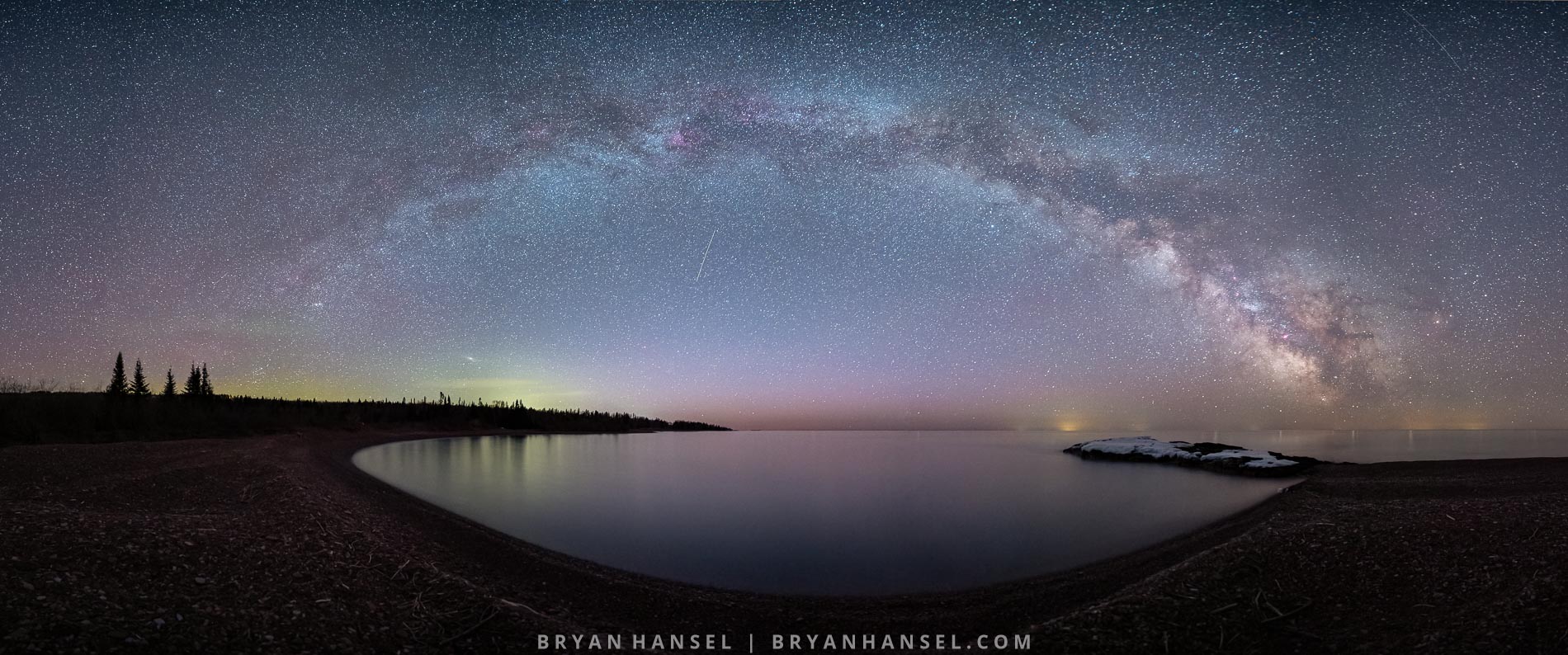
A three-night deep dive into panoramic photography and Milky Way panos on the dark shores of Lake Superior. Learn the techniques, gear, and processing needed to create sweeping night-sky panoramas.
Dates: May 6-8, 2027
Location: Grand Marais, MN
Cost: $599
Photographing the Milky Way is magical on its own, but capturing it as a sweeping panorama takes night photography to an entirely new level. During this three-day workshop, you’ll learn how to shoot single-row panoramic images during the day and how to photograph the Milky Way at night. Then, assuming conditions cooperate, you’ll bring those skills together to create a Milky Way panorama from one of the darkest locations in the lower 48.
Cook County’s combination of dark skies, Lake Superior’s shoreline, and quiet inland lakes makes it one of the premiere Milky Way photography destinations in the world. This workshop is designed to help you master the gear, technique, and post-processing needed to stitch clean, accurate panoramas and produce night-sky images you’re proud of.
Cost & Registration
Cost: $599
A non-refundable deposit of $300 is due at registration. The remaining $299 is due 90 days before the workshop (February 5, 2027).
This event is in cooperation with and under a Special Use Permit from U.S. Forest Service, Gunflint Ranger District.
Prerequisite
Because we cover multiple topics, including panoramic technique, night photography, and post-processing, having experience in night photography is helpful. Ideally, you’ll have taken a night photography workshop before you take this workshop. If you are unsure that you have enough experience, please, reach out to me to talk.
What You Will Learn
During this workshop, you’ll learn:
- How to shoot single-row panoramic images
- How to photograph the Milky Way with clean, consistent frames
- How to find the anti-parallax (nodal) point in your lenses
- How to set up and use specialized panoramic gear
- How to process panoramic images in Lightroom Classic and, if needed, Photoshop
- How to combine day and night techniques to produce a Milky Way panorama
This workshop blends classroom learning with real night-sky fieldwork—three nights in a row if conditions allow.


Required Gear for This Workshop
To get the most out of this workshop, you’ll need a panoramic setup that uses Arca-Swiss compatible components, a nodal slide, and an indexed 360° rotating base. These pieces allow you to accurately locate the anti-parallax point of your lens and create clean, stitchable frames. This is especially important for Milky Way panoramas. It’s also helpful to have a laptop or device running Adobe Lightroom Classic for stitching panoramic images. A fast (f/2.8 or faster) wide-angle lens is ideal.
Required items:
- Ballhead with Arca-Swiss quick release
- Indexed 360° rotating base with detents you can feel
- L-bracket for your camera body
- Nodal slide (length depends on lens)
- Sturdy tripod

If you already own gear that meets these requirements, you can use it. After registration, you’ll receive a detailed participant package with recommended brands, specific models, and assembly instructions.
Quick Notes
- Your L-bracket should have center markings on both the horizontal and vertical sides.
- The rotating base must have indexed detents, an Arca-Swiss plate on the bottom, and an Arca-Swiss clamp on top.
- Common options include (I may earn commissions if you shop through the links below):
- Andoer DH-60
- Sunwayfoto DDP-64si with the AM-01 Arca Dovetail Mount
- Nodal Ninja Fanotec Rotator (needs additional quick release clamp)
- Nodal slide length varies by lens. Most people use 150–180mm. It needs to reach to the end of your lens without ending up in the photo.
A full, illustrated gear guide that includes specific recommendations, alternatives, warnings, and how to assemble your pano rig will be provided in the participant package once you’re registered.
Gear Assembly Example
Example of the pano setup assembled: This is the basic configuration we’ll use during the workshop. From the bottom to the top: ballhead, indexed 360° rotating base, nodal slide, L-bracket (connected to the camear), and a camera with a fast wide-angle lens. During the workshop we’ll refine this and set your equipment up together.

Itinerary
Day 1 — May 6, 2027
1:00pm — Meet in the hotel conference room. We’ll cover the fundamentals of single-row panoramic photography and how to locate the anti-parallax point in your lenses using both traditional and laser-based methods. We’ll also cover how to use the required gear. You’ll break into small groups to find nodal points for your focal lengths.
5:00pm — Break for dinner.
7:00pm — Classroom instruction on photographing the Milky Way.
After class, we head into the field for night photography. We may be out until 3am.
Day 2 — May 7, 2027
2:00pm — Processing instruction: stitching panos in Lightroom Classic, basic retouching in Photoshop, and workflow considerations for night panoramas.
5:00pm — Break for dinner.
7:00pm — Sunset panoramic session followed by more night photography. We may be out until 3am.
Day 3 — May 8, 2027
2:00pm — Image review and Q&A. If we finish early, we’ll head into the field to practice panoramic techniques before dinner.
5:00pm — Dinner.
7:00pm — Sunset pano session followed by night photography. Expect another late night, possibly until 3am.
May 9, 2027 — Check-Out
No classroom time today. Many participants stay out late the previous night for additional Milky Way shooting.
The itinerary may shift based on weather and sky conditions.

Additional Information
Workshop type: This is a Minnesota photography workshop. It has classroom time, outdoor field time, and an image review session during the workshop dates. Learn more about workshop types.
Maximum number of participants: 10
Level: This workshop is for all levels of photographers and works best for photographers using digital cameras.
Activity level: Expect up to 3-mile round-trip walks on moderate terrain. Some trails may feel harder to some participants, but they are considered easy to moderate by standard ratings. If you have questions about ability or terrain, please call me.
What’s Included
- Small-group and one-on-one instruction
- Classroom space
- A fun and supportive learning environment
Not Included
- Transportation to Grand Marais and shooting locations (carpooling encouraged)
- Lodging
- Meals and drinks
- Park permits
Lodging partner: Our lodging partner is within walking distance of downtown Grand Marais. After registration, you’ll receive instructions for booking your room within the workshop block. Lodging is booked separately from the workshop fee.
Check-in date: May 6
Check-out date: May 8
Getting to Grand Marais: Grand Marais, Minnesota, sits 110 miles north of Duluth along Highway 61 and 260 miles north of Minneapolis. Duluth has a small international airport; Minneapolis is a major international hub. Grand Marais is also 128 kilometers south of Thunder Bay, Ontario.
Weather: Typical early-May temperatures range from mid-40s at night to low-60s during the day.
Equipment list: After registration, you’ll receive a complete equipment list and participant package covering gear, techniques, and workshop logistics.
Registration and Cancellation Policies
Please, read the Registration and Cancellation Policies at the link. There are no exceptions.