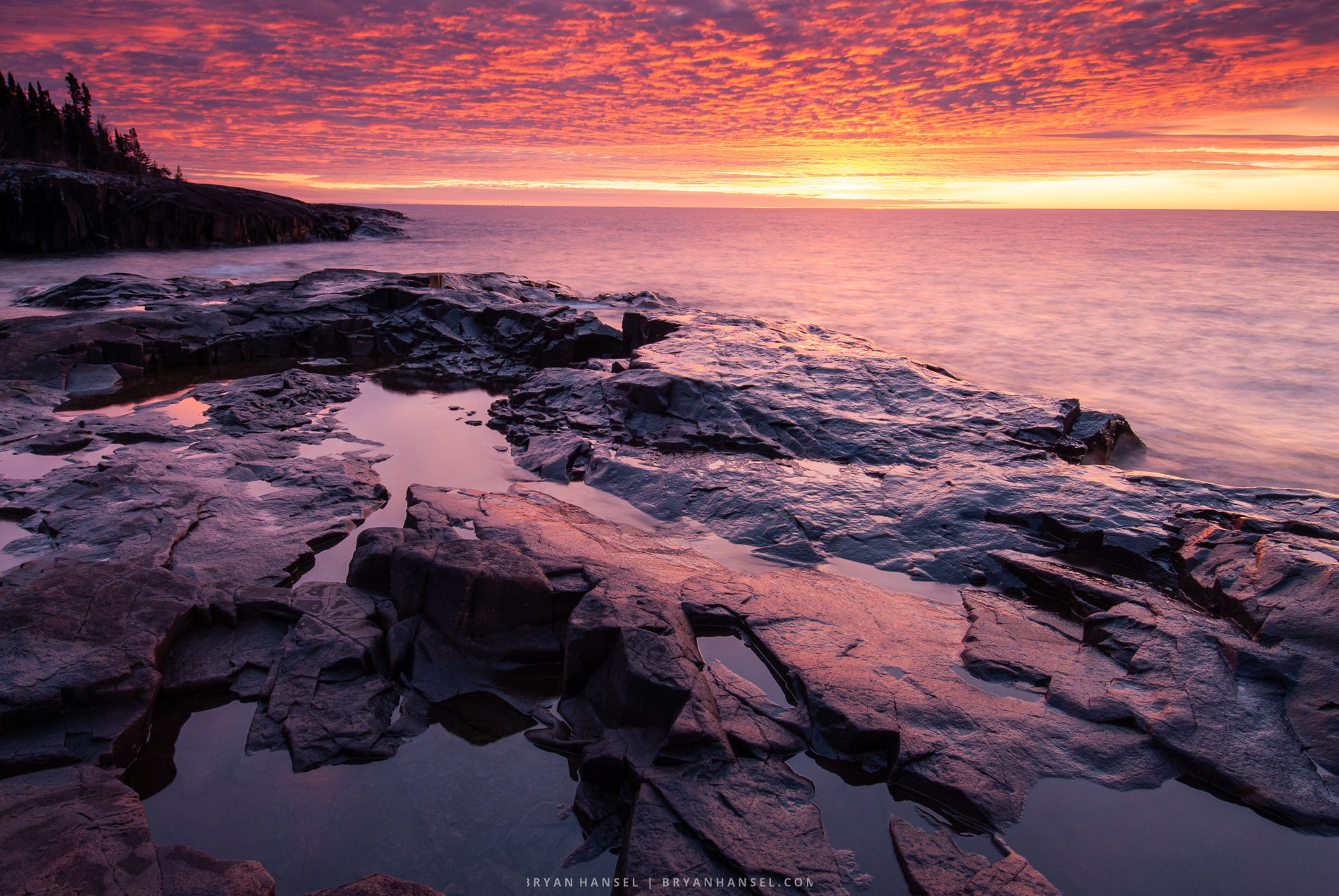
Artist’s Point is the most photogenic location in Grand Marais and one of the best photography spots on the entire North Shore. It’s a five-minute walk from downtown, it works in every season, and it offers enough compositional variety that you could shoot there for years without running out of new angles. Here’s what you need to know to make the most of it.
How to Get There
You’ll find Artist’s Point in Grand Marais, and it’s one of the easiest and most scenic photography locations on the North Shore. At the only stoplight in Cook County, turn towards Lake Superior until you get to the U.S. Coast Guard building parking lot. From the parking lot, walk towards the lake until you see the sign for Artist’s Point. Turn right (west) to walk towards the lighthouse. Turn left (east) to walk towards Artist’s Point itself.
Keep in mind that the shore runs almost due east and west in Grand Marais, which feels a little disorienting if you expect Highway 61 to run north. If you have that mindset, you’ll end up looking south during the sunrise wondering where the sun is.
Best Season and Date Range
Artist’s Point works year-round, but the best sunrise dates — when the sun rises over Lake Superior rather than inland — run from approximately August 25th through April 20th. For lighthouse sunsets, plan to be there between October 15th and March 1st, with November through February being the strongest months when the sun sits furthest over the lake.
On overcast days, Artist’s Point is worth visiting for wildflower photography. Look for harebells growing out of cracks in the rock, and with some searching you may find fireweed and columbine. Head into the woods for more variety — bunchberries are particularly scenic. If you search carefully, you may find the rare butterwort.
Best Time of Day
Sunrise for Artist’s Point. Sunset for the lighthouse. Overcast days for flowers. Midday offers harsh, unphotogenic light and makes it hard to shoot anything worth keeping. Skip it midday.
The Six Areas
Artist’s Point divides into six distinct areas, each with different photographic possibilities.

The Point almost always works well no matter the time of year. Even in summer when the sun rises too far inland to appear over the lake, you can still get good color at sunrise. Two small islands sit just off the point and waves break over them whenever the lake has any energy at all. Watch for reflections in puddles — they make excellent foregrounds.

The East Bay offers a rocky shoreline that makes for an okay photo on its own, but the real draw is the old dock pilings that punch through the beach and water’s surface. This area works best at the edges of the date range, when the sun rises far enough north to light up the bay. The north side of Artist’s Point is lined with five to ten foot cliffs that freeze early in winter and stay in shadow all season long.

Between the breakwall and the point you’ll find a rocky shore with several large cracks and gullies that split the point apart. These photograph best in January and February when the sun is at its furthest south.

The breakwall area is also strongest in January and February. The rocks here are smoother and sit closer to the water than on the point. There’s a section of very jagged rocks that works well for sunset — and sunsets from this area almost always include the lighthouse. It’s nearly impossible to avoid it, which is usually a good thing. Where the path from the Coast Guard building meets the breakwall, keep an eye out for Inuksuit — rocks balanced on other rocks — which are worth a few minutes of your time. Just west of the path, water runs behind the basalt rocks and creates interesting foreground options.

The lighthouse is the classic Grand Marais shot, and the best way to get it is from the Coast Guard parking lot with a telephoto. That said, don’t overlook the breakwall area for lighthouse shots — the angle is different and often just as interesting.

The harbor side of Artist’s Point is characterized by knee-high to head-high brush that’s difficult to photograph most of the year. The exception is winter, before the harbor freezes, when a strong north wind blows spray over the brush and coats everything in ice. The result is a landscape full of unusual shapes and textures that combines beautifully with a deep blue winter sky. If you’re into wildlife, I’ve seen otters, mink, and a beaver working this stretch of shoreline.
What Gear to Bring
For sunrise, think wide and bring at least 24mm in full frame equivalent. There are so many foreground options on Artist’s Point that I’ve been shooting there for years and still haven’t worked through them all. Every trip out I find something I haven’t tried before.
For lighthouse sunsets, bring a telephoto. 200mm is the minimum, 300mm is better. When it’s stormy and waves are breaking over the lighthouse, 400mm is worth having.
For flowers, the blooms on Artist’s Point are small and delicate. A 105mm macro lens with extension tubes is the right tool for getting close without disturbing them.
Notes
Despite being a five-minute walk from downtown Grand Marais, you’ll often have all of Artist’s Point to yourself at sunrise. If you’d like a guided introduction to shooting here and other North Shore locations, I teach photography workshops in Grand Marais throughout the year.
Leave a Reply